
Transceiver Modules
26 results
Transceiver Modules
26 results
Pluggable transceiver modules for switches, routers and network interface cards. The selection covers SFP, SFP+, SFP28, QSFP+ and QSFP28 form factors at 1, 10, 25, 40 and 100 GbE; optical modules in SR, LR, ER and ZR variants for different reaches; copper RJ45 transceivers; and direct-attach copper (DAC) cables for short rack runs.
Loading...


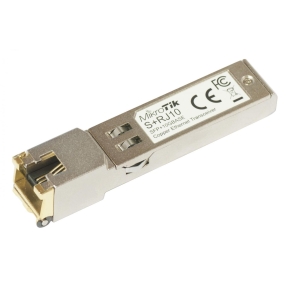
SFP, SFP+ and QSFP transceiver modules for switches and routers
The transceiver decides what the SFP cage on a switch actually does. The same physical cage can carry gigabit copper, gigabit fibre, 10 GbE short-reach, 10 GbE long-reach or a direct-attach copper cable, depending on the module plugged in. Picking the right transceiver is more important than the switch model itself for the link's actual performance.
What this category covers
SFP modules at 1 GbE: 1000BASE-T copper, 1000BASE-SX/LX/EX/ZX fibre. SFP+ at 10 GbE: 10GBASE-T copper, SR/LR/ER/ZR fibre, BiDi single-fibre. SFP28 at 25 GbE for data centres. QSFP+ at 40 GbE and QSFP28 at 100 GbE for high-speed uplinks and inter-switch links. Direct-attach copper (DAC) cables in 1, 3, 5 metre lengths.
How to choose a transceiver module
Match the form factor to the cage
SFP/SFP+ cages take SFP/SFP+ modules. QSFP+ cages take QSFP+ modules. Forms cannot be mixed without a breakout cable. Confirm the switch's cage type before ordering. Some switches support breakout (one QSFP cage to four SFP+ links), useful for connecting one 40 GbE port to four 10 GbE servers.
Pick the optical reach for the actual link
SR (Short Reach) modules for multimode fibre runs up to 300-400 metres. LR (Long Reach) for single-mode fibre up to 10 km. ER (Extended Reach) for 40 km. ZR for 80 km. Pick by the actual cable length plus margin for connector loss; oversized reach modules cost more and have higher transmit power that the receiver may not tolerate.
Use DAC for short rack-internal runs
Direct-attach copper cables in 1, 3, 5 metre lengths are cheaper than two transceivers plus a fibre patch cord and use less power. They only work over short distances and need compatible cages on both ends. Almost universal in modern data centres for top-of-rack to server connections.
Confirm vendor coding
Many switches accept generic third-party modules; some lock to vendor-coded transceivers. "Compatible coded" third-party modules from reputable vendors usually work and cost a fraction of OEM. Confirm against the switch model and consider OEM for mission-critical installs.
Key features to compare
Transmit power and receiver sensitivity
Transmit power and receiver sensitivity (in dBm) determine how much fibre loss the link can tolerate. Long-reach modules have higher transmit power and more sensitive receivers. The link budget (transmit power minus receiver sensitivity) needs to exceed the total fibre loss with margin.
Wavelength
Standard wavelengths are 850 nm (multimode), 1310 nm (single-mode short), 1550 nm (single-mode long). CWDM and DWDM modules use specific wavelengths in 20 nm or 0.8 nm spacings to allow multiplexing many channels on one fibre.
Digital diagnostic monitoring
DDM (Digital Diagnostic Monitoring), also called DOM, reports transmit power, receive power, temperature and laser current to the switch software. Useful for monitoring and troubleshooting; included on most modern transceivers.
What to check before buying
- Cage type and the speed it supports?
- Fibre type and length already in place?
- Vendor-coded transceiver required, or generic OK?
- DAC for short rack runs, or fibre transceivers for longer links?
- BiDi single-fibre transceivers if fibre count is limited?
Frequently asked questions
Are third-party transceivers as reliable as OEM?
For typical use, yes. Reputable third-party brands (FS, FluxLight, ProLabs and similar) source the same Finisar, Lumentum and Source Photonics optics OEMs use, and code them to identify as the switch vendor's part number. The differences appear in vendor support and edge-case features. For most installs, third-party saves 50-80 percent without measurable downsides.
What is a BiDi transceiver?
BiDirectional transceivers send and receive on the same fibre using two different wavelengths (often 1310 and 1550 nm). They double the available capacity on existing fibre infrastructure: instead of a fibre pair (one transmit, one receive), one fibre carries both directions. Useful when fibre count is limited.
Can I use a 10 GbE transceiver in a gigabit cage?
SFP+ modules generally work in SFP cages at the lower speed (1 GbE) if the switch supports it. The reverse (SFP module in SFP+ cage at 1 GbE) usually works. Auto-negotiation between modules and cages varies by switch; check the switch's compatibility matrix.
How do I read DDM information?
Most managed switches expose DDM data through a CLI command ("show interface transceiver" on Cisco, "show transceiver detail" on others) or in the web UI. The values to watch are transmit power (should be in the module's spec range), receive power (above the receiver sensitivity by at least 3 dB margin), and temperature (below 70 °C in normal operation).
What is QSFP breakout?
A QSFP+ cage carries 40 GbE as 4 lanes of 10 GbE. With a breakout cable, one QSFP+ port on a switch becomes four 10 GbE ports for connecting to four servers. QSFP28 to 4x SFP28 breakout works the same way at 100 GbE to 4x 25 GbE. Common in dense top-of-rack installs.